On Thursday, February 27, 1913, Woodrow Wilson sat at the State House in Trenton, New Jersey, and opened his mail. He was 56 years old, the governor of New Jersey and the former head of Princeton University. In five days he would be President of the United States. In one envelope he found a dare. With it came a little box of brown clay marbles.
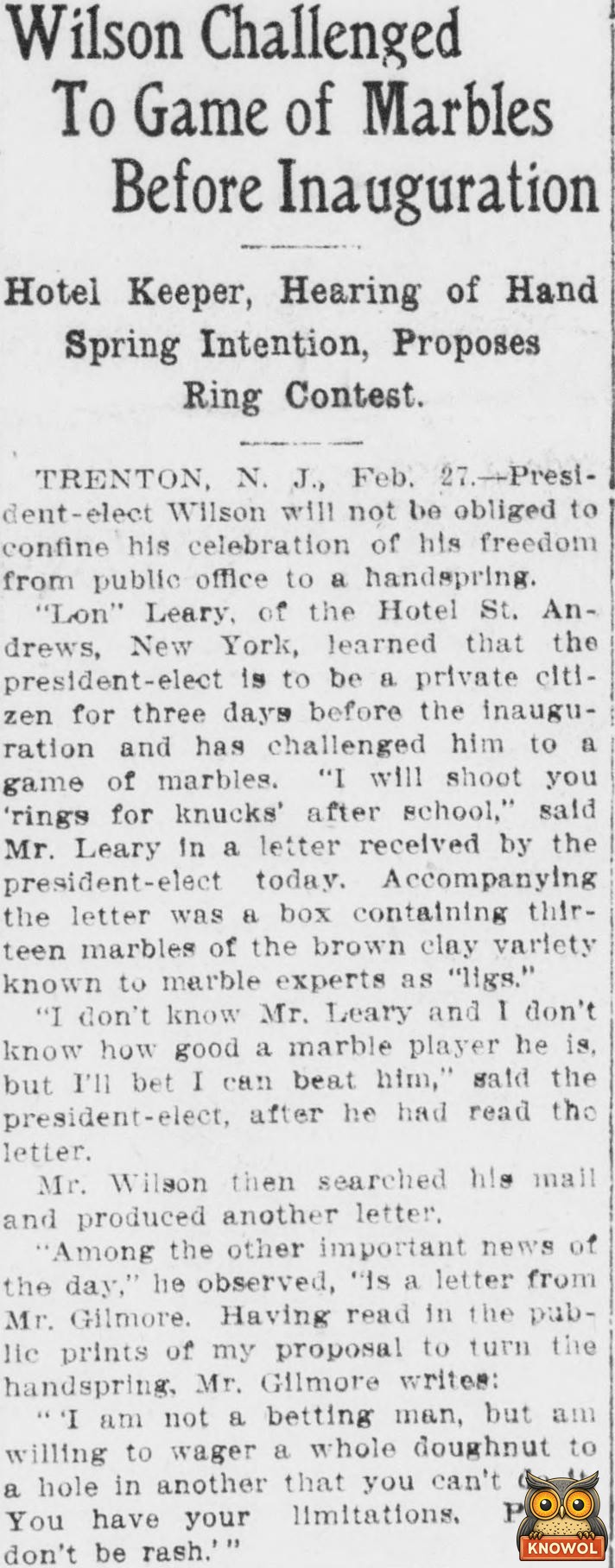
“Wilson Challenged To Game of Marbles Before Inauguration.” The Atlanta Georgian, Atlanta, Georgia, February 28, 1913, page 1. Library of Congress, Chronicling America. Click the clipping to read it full size.
Three days off
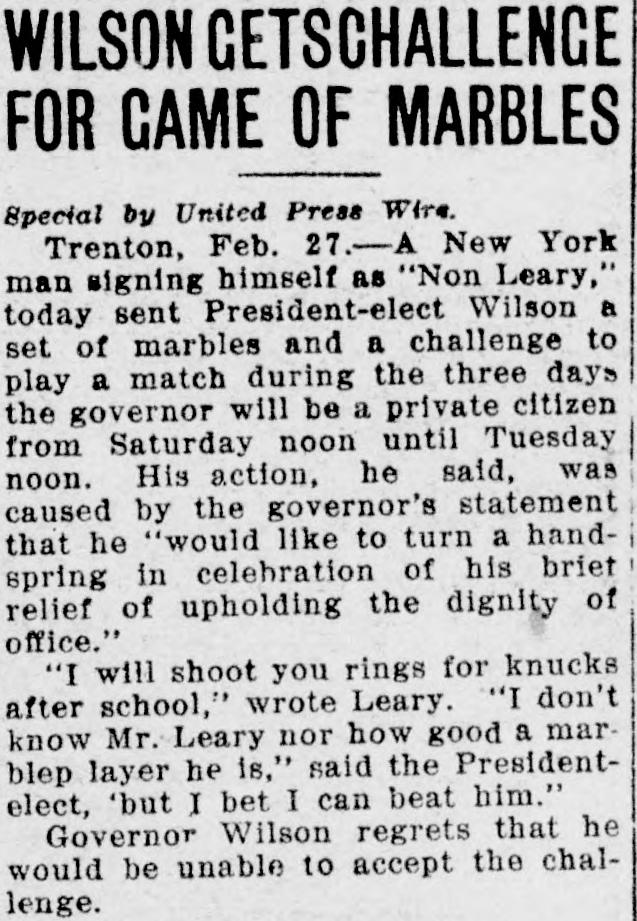
The dare started with a joke Wilson had made himself. His job as governor would end at noon on Saturday, March 1. His job as president would start at noon on Tuesday, March 4. For the three days in between, he would hold no office at all. He would be a plain citizen, like his neighbors. Wilson said he would like to turn a handspring “in celebration of his brief relief of upholding the dignity of office,” the United Press reported. A handspring is when you flip forward onto your hands and come back up on your feet. Picture a serious professor in a long wool coat trying one on the State House lawn.
The dare in the box
A New York man read about the handspring and had a better idea. He was “Lon” Leary of the Hotel St. Andrews, and the papers called him a hotel keeper. (Some of them spelled his name “Non.”) He mailed the next president a challenge to a game of marbles. “I will shoot you ‘rings for knucks’ after school,” he wrote.
That was pure schoolyard talk. Rings was a marble game. You drew a circle on the ground, set marbles in the middle and knelt at the edge. Then you flicked your shooter marble with your thumb to knock the others out of the ring. Knucks was another kind of marble game. And “after school” was a sly joke for a man who had spent most of his life in schools, first as a student, then as a professor, then as Princeton’s president.
The box held “thirteen marbles of the brown clay variety,” by the Atlanta Georgian’s count. Other papers said fifteen. Either way, they were the plain, cheap kind every kid had in a pocket.
“I’ll bet I can beat him”
Wilson did not toss the letter aside. He answered it like a boy at recess. “I don’t know Mr. Leary and I don’t know how good a marble player he is, but I’ll bet I can beat him,” he said.
Someone in the room wanted to know more. “If you accept the match you will play for keeps?” the president-elect was asked, according to the Virginia Gazette. Playing for keeps meant the winner went home with every marble he knocked out. Wilson laughed. Mr. Leary, he said, had not named the stakes yet.
A doughnut bet
Then Wilson dug through his mail and pulled out another letter. “Among the other important news of the day,” he said, was one from a Mr. Gilmore. Mr. Gilmore had read about the handspring in the “public prints,” which meant the newspapers. He was worried. “I am not a betting man, but am willing to wager a whole doughnut to a hole in another that you can’t do it. You have your limitations. Please don’t be rash.”
Look closely at that bet. If Wilson lost, Mr. Gilmore got a whole doughnut. If Wilson won, he got the hole from the middle of a doughnut. In other words, nothing at all.
“Wilson Gets Challenge for Game of Marbles.” The Perth Amboy Evening News, Perth Amboy, New Jersey, February 27, 1913, page 3. Library of Congress, Chronicling America. Click the clipping to read it full size.
Meanwhile, in Washington
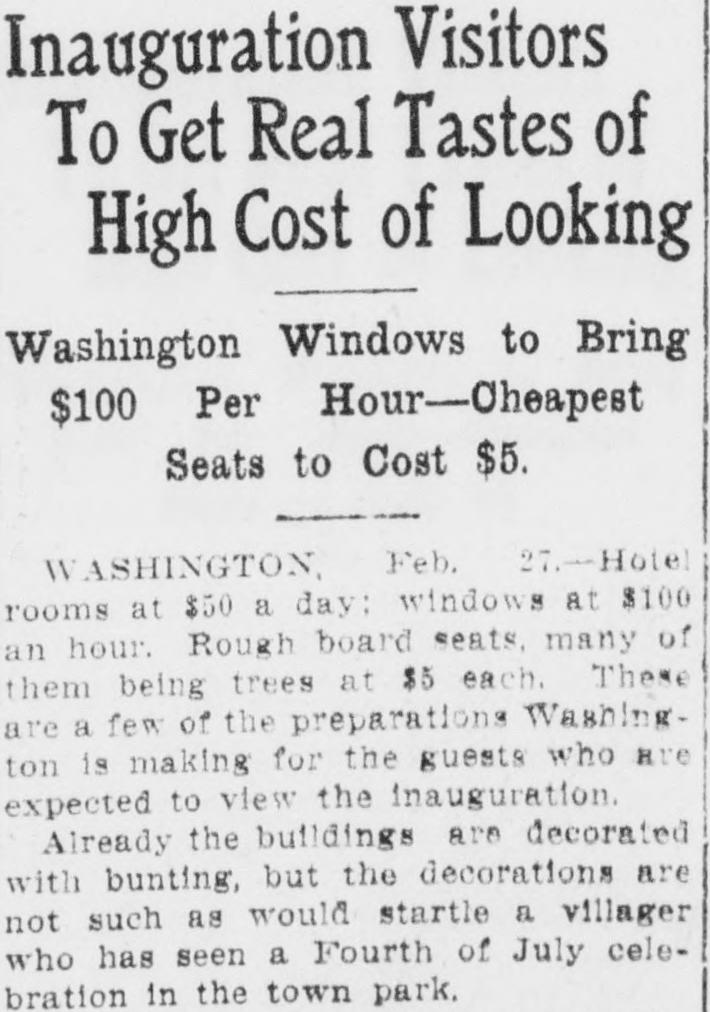
The same front page of the Atlanta Georgian showed what was waiting for Wilson in Washington. Hotel rooms cost $50 a day. A window looking out on the parade cost $100 an hour. The cheapest seats cost $5, and they were not fancy: “Rough board seats, many of them being trees at $5 each.” For five dollars, you might watch the new president go by from a tree branch.
“Inauguration Visitors To Get Real Tastes of High Cost of Looking.” The Atlanta Georgian, Atlanta, Georgia, February 28, 1913, page 1. Library of Congress, Chronicling America. Click the clipping to read it full size.
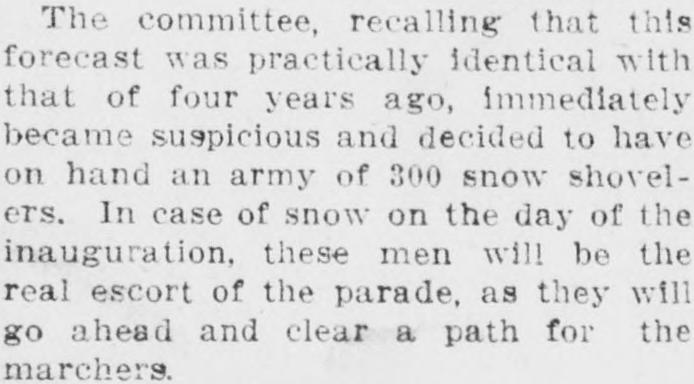
The weather bureau promised mild, clear skies for Inauguration Day. The planners did not trust it. That forecast was almost the same one they had heard four years before, when a blizzard hit Washington on the day President Taft took office. So the committee “immediately became suspicious and decided to have on hand an army of 300 snow shovelers.” If it snowed, the shovelers would march first and clear a path for the parade.
The 300 snow shovelers. The Atlanta Georgian, Atlanta, Georgia, February 28, 1913, page 1. Library of Congress, Chronicling America. Click the clipping to read it full size.
No match, no handspring
In the end, the next president turned the hotel man down. “Governor Wilson regrets that he would be unable to accept the challenge,” the United Press reported.
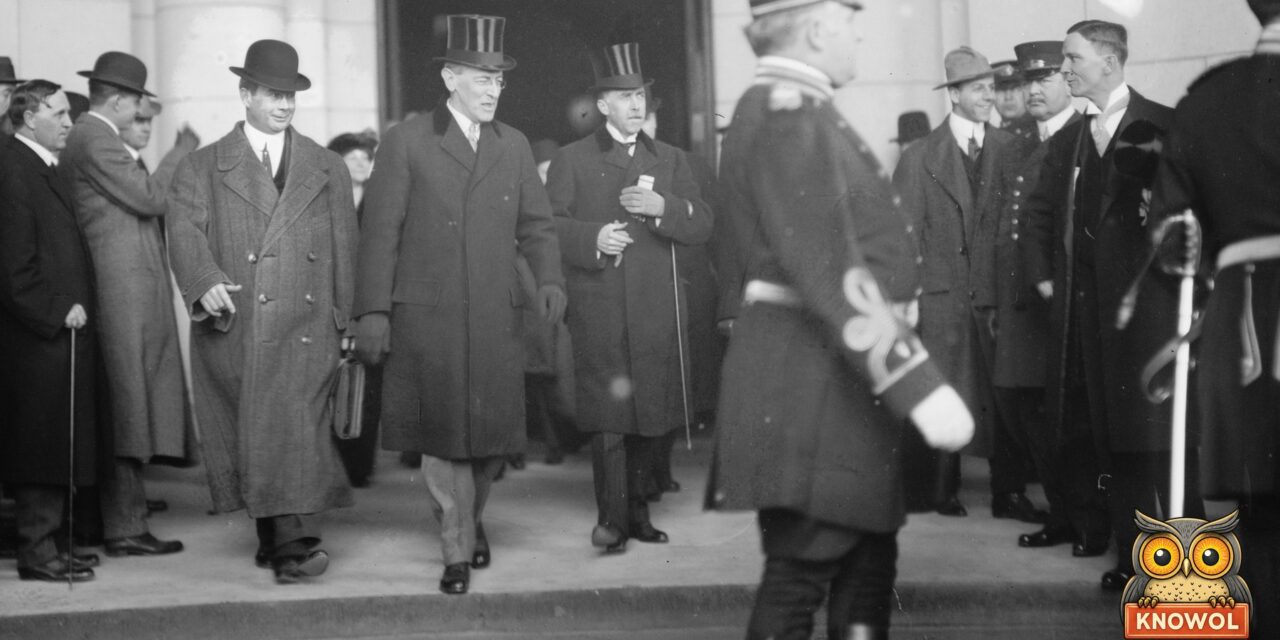
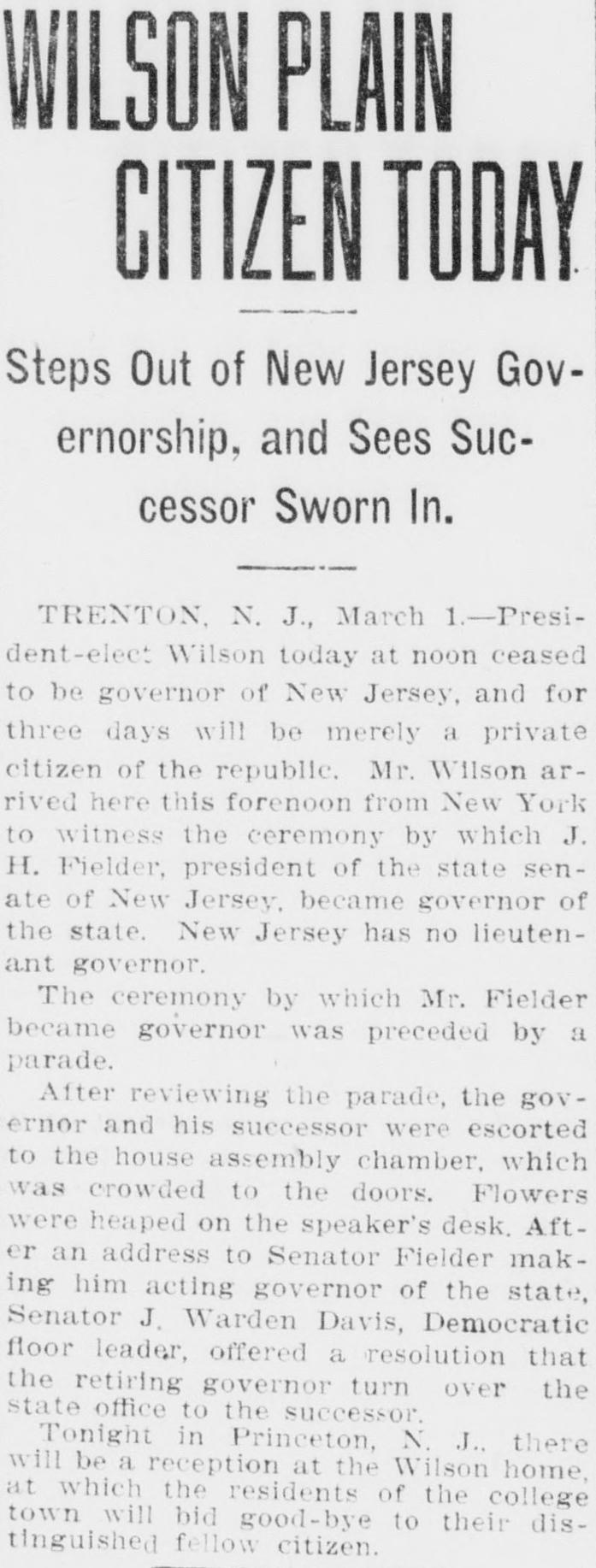
At noon on Saturday, March 1, Wilson stopped being governor. “Wilson Plain Citizen Today,” the Atlanta Georgian’s headline said. New Jersey had no lieutenant governor, so the president of the state senate took over. That night, his neighbors in Princeton, New Jersey, were invited to a goodbye party at his home. On Monday, March 3, he took the train to Washington. The photo at the top of this story shows him walking out of the train station there that day in a top hat, still a private citizen. The next day he became the 28th president.
“Wilson Plain Citizen Today.” The Atlanta Georgian, Atlanta, Georgia, March 1, 1913, page 2. Library of Congress, Chronicling America. Click the clipping to read it full size.
No paper we found ever reported a handspring or a marble game. Grown men did get down on their knees to shoot marbles, though. In the photo below, from April 26, 1924, four men in suits kneel around a ring while the boys watch to see how they do. Two years after that, a 10-year-old boy became the marble king of New Britain, Connecticut.
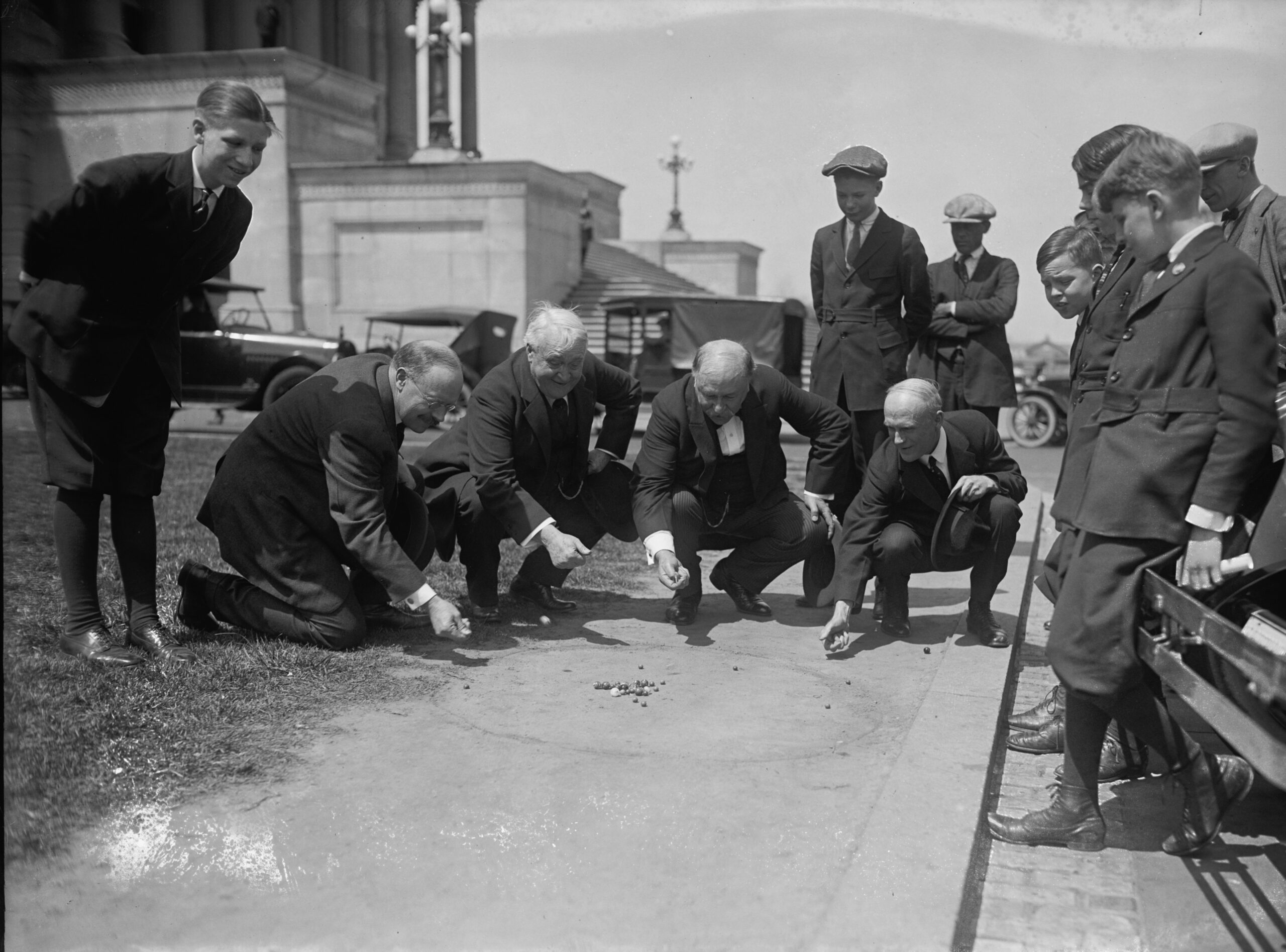
Grown men in suits kneel to shoot marbles in a ring while boys watch, April 26, 1924. This is not Wilson or Leary. National Photo Company, Library of Congress. Click the picture to see it full size.
Mr. Leary never got his game. But for a few days in 1913, the busiest man in America held a box of clay marbles in his hand and said what any kid would say: “I’ll bet I can beat him.”
Sources
- The Atlanta Georgian (Atlanta, Georgia): February 28, 1913, page 1 (“Wilson Challenged To Game of Marbles Before Inauguration,” “Inauguration Visitors To Get Real Tastes of High Cost of Looking,” “300 Snow Shovelers Hired by Committee”); March 1, 1913, page 2 (“Wilson Plain Citizen Today”).
- The Perth Amboy Evening News (Perth Amboy, New Jersey): February 27, 1913, page 3 (“Wilson Gets Challenge for Game of Marbles,” United Press).
- The Virginia Gazette (Williamsburg, Virginia): March 6, 1913, page 2 (the “play for keeps” question).
- The same story also ran in the Richmond Palladium (Richmond, Indiana), the New Haven Journal-Courier and the Evening Times-Republican (Marshalltown, Iowa).
- Knucks as a kind of marble game: The Beginnings of Public Education in Virginia, 1776-1860 (1917), Internet Archive.
- Cover photo: Bain News Service, “Wilson arrv’g. in Wash’n.”, March 3, 1913. George Grantham Bain Collection, Library of Congress. No known restrictions on publication.
- Marbles photo: National Photo Company, “Marbles, 4/26/24”. National Photo Company Collection, Library of Congress. No known restrictions on publication.
- All newspaper images: Library of Congress, Chronicling America. Published 1913.